



Joint ventures and a strong regional presence let us offer
tailored on-site support across South Africa.

A South African gold plant crushes and mills ore to a fine grind, recovers free gold by gravity, dissolves the rest in cyanide and adsorbs it on activated carbon. Most of the consumable spend sits in four places: the mill (grinding media and liners), the cyclone and pump circuit, the screens that keep carbon where it belongs, and the chutes and launders that carry abrasive slurry. This page maps those stages to Songatech products.
Almost all South African gold comes from the Witwatersrand Basin. The main districts are the West Rand around Carletonville, Westonaria and Randfontein; the East Rand around Springs, Brakpan and Nigel; the Free State goldfield around Welkom, Virginia and Odendaalsrus; and the Klerksdorp and Orkney area in North West. Barberton in Mpumalanga is a separate, older greenstone goldfield.
Two kinds of plant run side by side. Deep underground mines, some working below 3 km, hoist ore to conventional mill and leach plants. Tailings retreatment plants on the East and West Rand reclaim old dumps with high pressure water monitors, pump the slurry to a central plant, and often regrind before leaching. Retreatment plants skip crushing but pump very large volumes over long distances, so pumps, pipes and launders take most of the wear. See mining supplies in Gauteng and mining supplies in the Free State for the regional view.

Witwatersrand ore is hard and quartz rich, and it is commonly ground to about 75 µm (P80) so the gold is exposed to the leach solution. Large plants use SAG or run-of-mine mills followed by ball mills; smaller plants run ball mills alone. Forged grinding balls of 100 to 125 mm suit primary and SAG duty where impact dominates, and cast high chrome balls suit regrind and corrosive pulps. Songatech balls cover 20 to 125 mm at 55 to 65 HRC, and stock items typically dispatch within 24 to 48 hours. The grinding ball cost per tonne guide explains how to compare media on wear rate rather than price per tonne of balls.
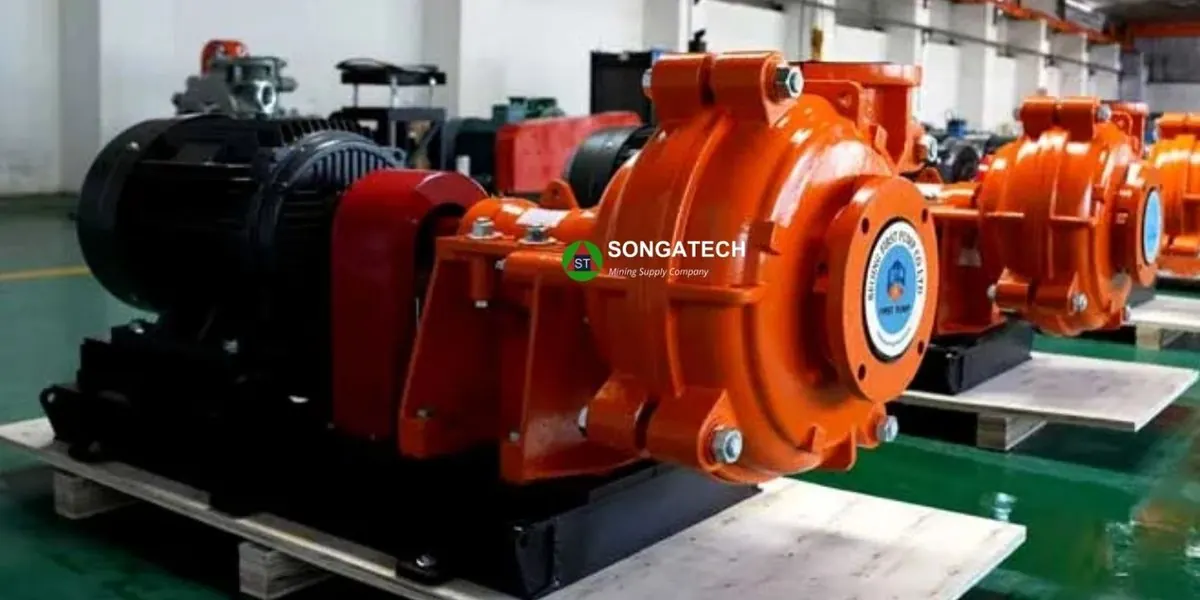
Mill discharge is pumped to a cyclone cluster. The underflow returns to the mill and the overflow goes on to leach. The mill discharge pump and the cyclones are among the fastest wearing items in any gold plant; high chrome slurry pumps and polyurethane hydrocyclones with replaceable spigots keep the cut steady. Our article on cyclone feed pumps covers pressure and speed control.
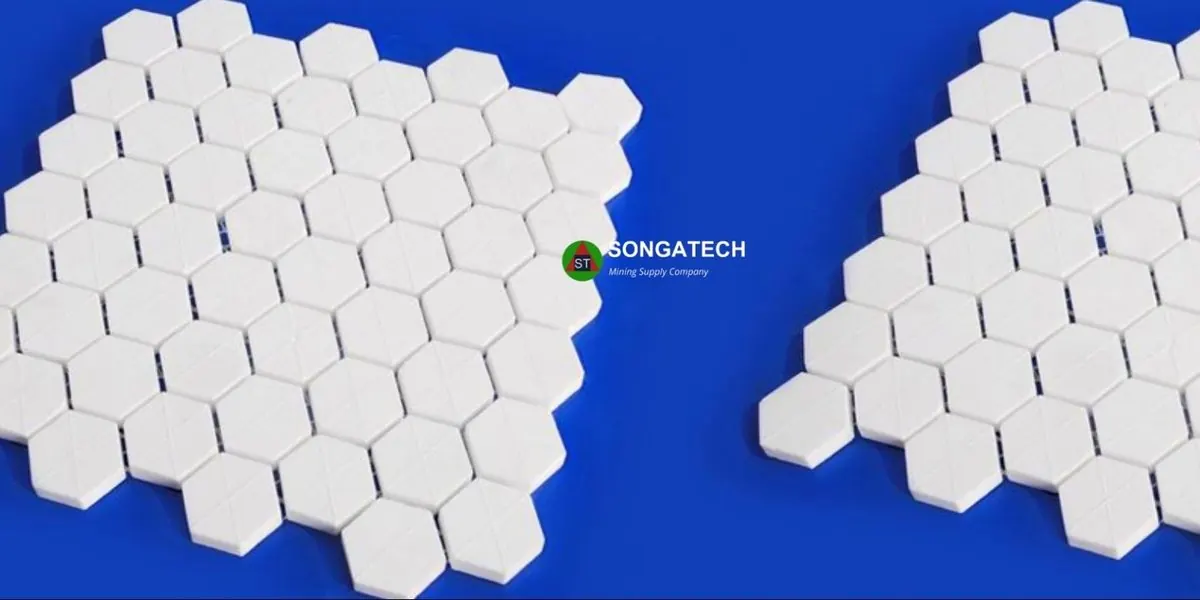
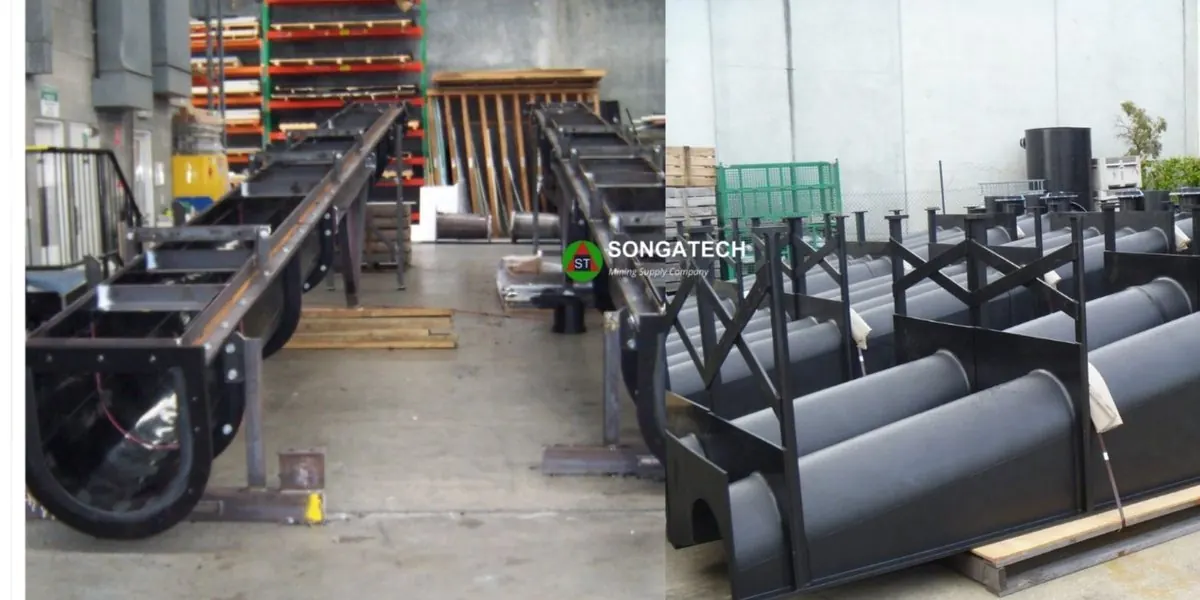
Coarse free gold concentrates in the cyclone underflow because it is so dense, so many plants bleed part of the underflow to centrifugal concentrators and send the concentrate to intensive leaching. The feed chutes and launders around these units carry the coarsest, most abrasive slurry in the plant. Alumina ceramic tiles (92% or 95% alumina, 6 to 50 mm thick) are the usual lining, with ZTA or rubber backed tiles where lumps drop onto the surface.
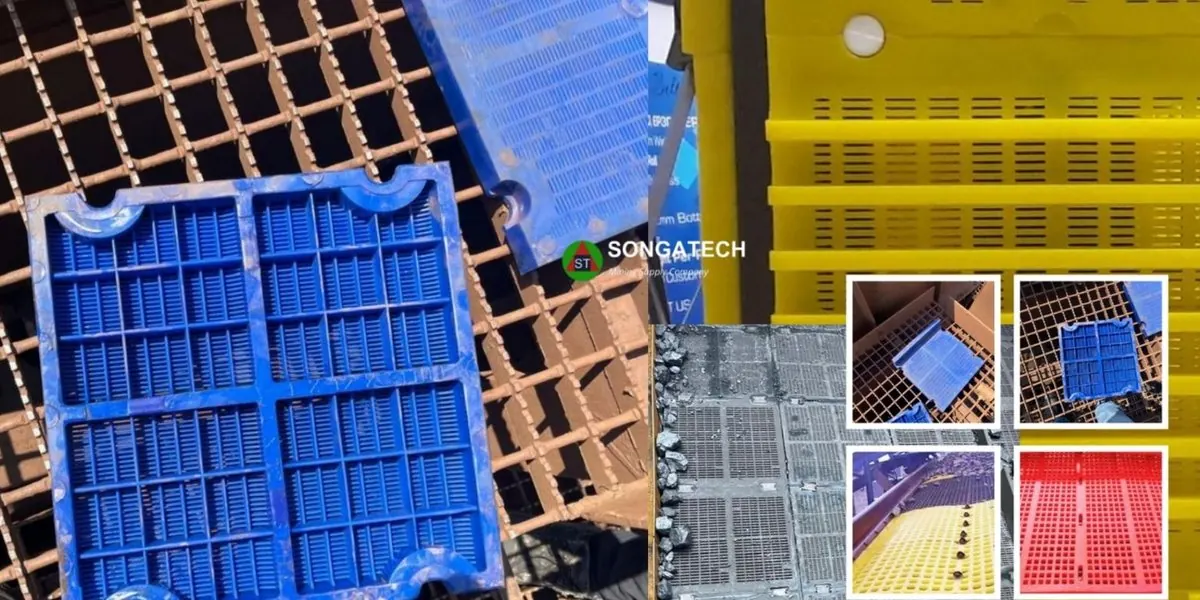
Before leach, a trash screen removes wood chips, plastic and coarse grit that would block interstage screens or foul the carbon. In carbon-in-leach (CIL) and carbon-in-pulp (CIP) plants, activated carbon, commonly 6 x 12 mesh (about 1.7 to 3.35 mm), moves counter-current to the pulp. Interstage screens with apertures smaller than the carbon, often around 0.6 to 0.85 mm, keep it in each tank, and a carbon safety screen on the tails catches any that escapes. A torn panel on these screens loses loaded carbon, and gold with it.
Songatech PU and wedge wire panels (slots from 0.25 to 2 mm) suit trash, carbon safety and dewatering screens; interstage screens are often proprietary, so send the screen make and drawings first. Stainless steel wire mesh suits wet, corrosive screening where mild steel would rust out.
| Stage | Typical equipment | Wear or consumable problem | Songatech products that fit |
|---|---|---|---|
| Underground mining | Stoping and development at depth, often below 2 km | Hanging wall and sidewall support under high stress | Roof bolts and cable anchors, Oslo straps |
| Crushing and conveying | Jaw and cone crushers, transfer chutes, conveyors | Chute liner wear, belt cuts and cover wear | Ceramic chute linings, conveyor belts |
| Milling | SAG, ROM and ball mills, rod mills in some older plants | Media wear rate and breakage, mill motor duty | Grinding balls, milling rods, electrical motors |
| Classification | Cyclone cluster and mill discharge pump | Spigot and cone wear, pump wet end wear | PU hydrocyclones, slurry pumps |
| Gravity recovery | Centrifugal concentrators on cyclone underflow | Abrasive feed launders and chutes | Lined launders, ceramic tiles |
| Trash and carbon screening | Linear trash screen, interstage screens, carbon safety screen | Panel wear, torn apertures that let carbon escape | PU and wedge wire panels, stainless steel mesh |
| Leach and tailings | Leach and CIL tanks, transfer and tailings pumps, long pipelines | Pump and pipe wear, launder wear | Slurry pumps, launders, ceramic linings |
Forged balls of 100 to 125 mm suit SAG and primary mills, where impact toughness matters most. Secondary mills use forged 80 to 100 mm or cast 60 to 90 mm balls. Cast high chrome balls suit regrind and corrosive pulps.
Witwatersrand ore is quartz rich and very abrasive, and mild steel launders wear through quickly. Alumina ceramic tiles resist sliding abrasion far better, and ZTA or rubber backed tiles handle impact zones.
Trash screens and carbon safety screens commonly use polyurethane or wedge wire panels with fine slots. Interstage screens need apertures smaller than the carbon, often around 0.6 to 0.85 mm. Send the screen make and current aperture to match a panel.
Mill discharge and cyclone feed pumps, because they handle the coarsest, densest slurry. High chrome wet ends are the usual choice for these duties, with rubber lined pumps for finer slurries.
Yes. Songatech supplies resin anchored rebar, mechanical anchor bolts, friction stabilisers and cable bolts, with Oslo straps, plates and mesh. Patterns follow the mine support standard.
For grinding media, pumps, screen panels or ceramic linings for a gold plant, send your duty details through the Songatech contact page or browse all mining products.
Send us the product, quantity and site. For linings and nozzles, include drawings or dimensions and we will match them to your equipment.